Scene 1 / 6
At the center of the country
Kansas City sits at the geographic and logistical heart of the United States. This is where the South Vine District is.
Market Study & Demand Analysis
An institutional market analysis supporting 500 Together.Homes KC — a $50 million master revolving facility financing a 500-home development delivered in five phases over 30 months in the urban core of Kansas City, Missouri. Anchored by an independent third-party USPAP appraisal consultation from Todd Appraisal, with HUD, MARC, and Census data.
Where this is
Loading map…
At a Glance
500 Together.Homes KC concentrates 500 new-construction transactions in a single Kansas City census tract over 30 months — five phases of 100 homes, with Phase 1 complete by month 9. The scale and coordination are not incidental — they are the mechanism by which the development carries the proven new-construction comps from adjacent Beacon Hill across the corridor and makes 500 sales the dominant local comparable set, unlocking private capital at scale.
500
Homes delivered in five phases over 30 months
$50M
Master revolving facility (development + land bank)
$459K
Blended sale price
252
Homes inside the workforce band (80–120% AMI)
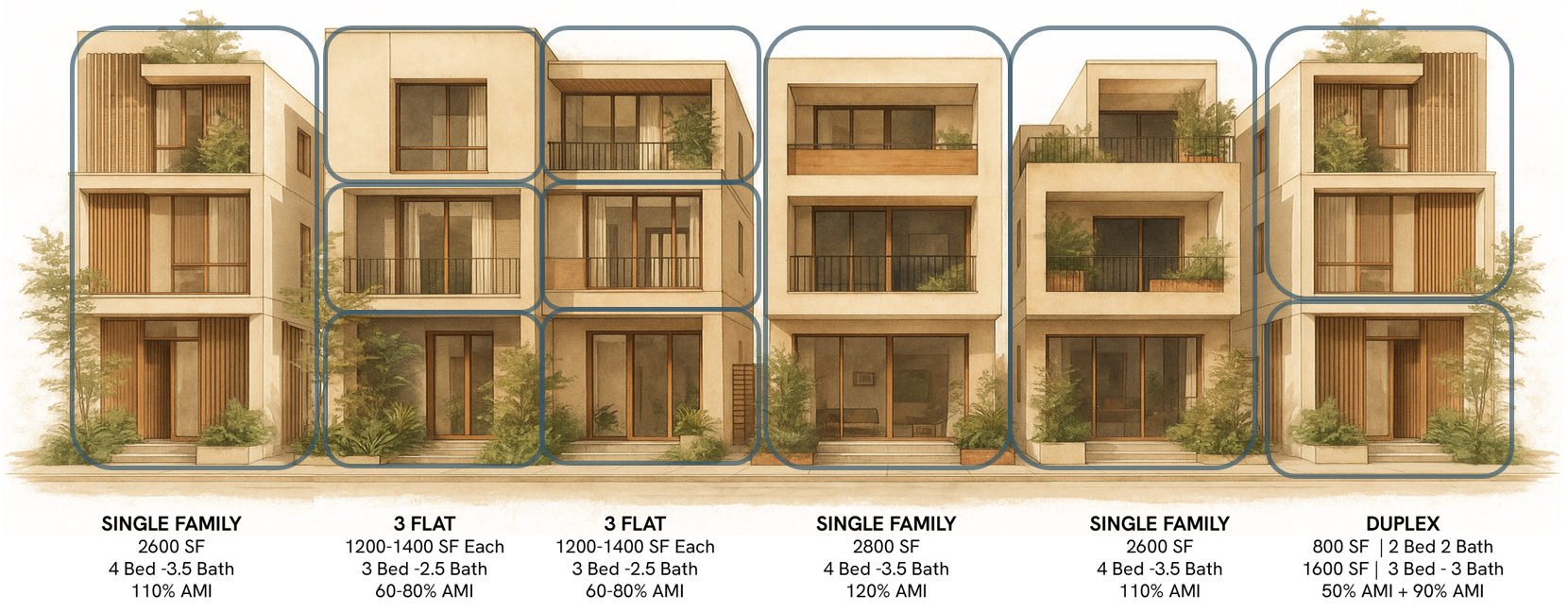
These tiers leverage similar footprints and building layouts to increase the density of housing options while preserving the overall scale and character of the neighborhood.
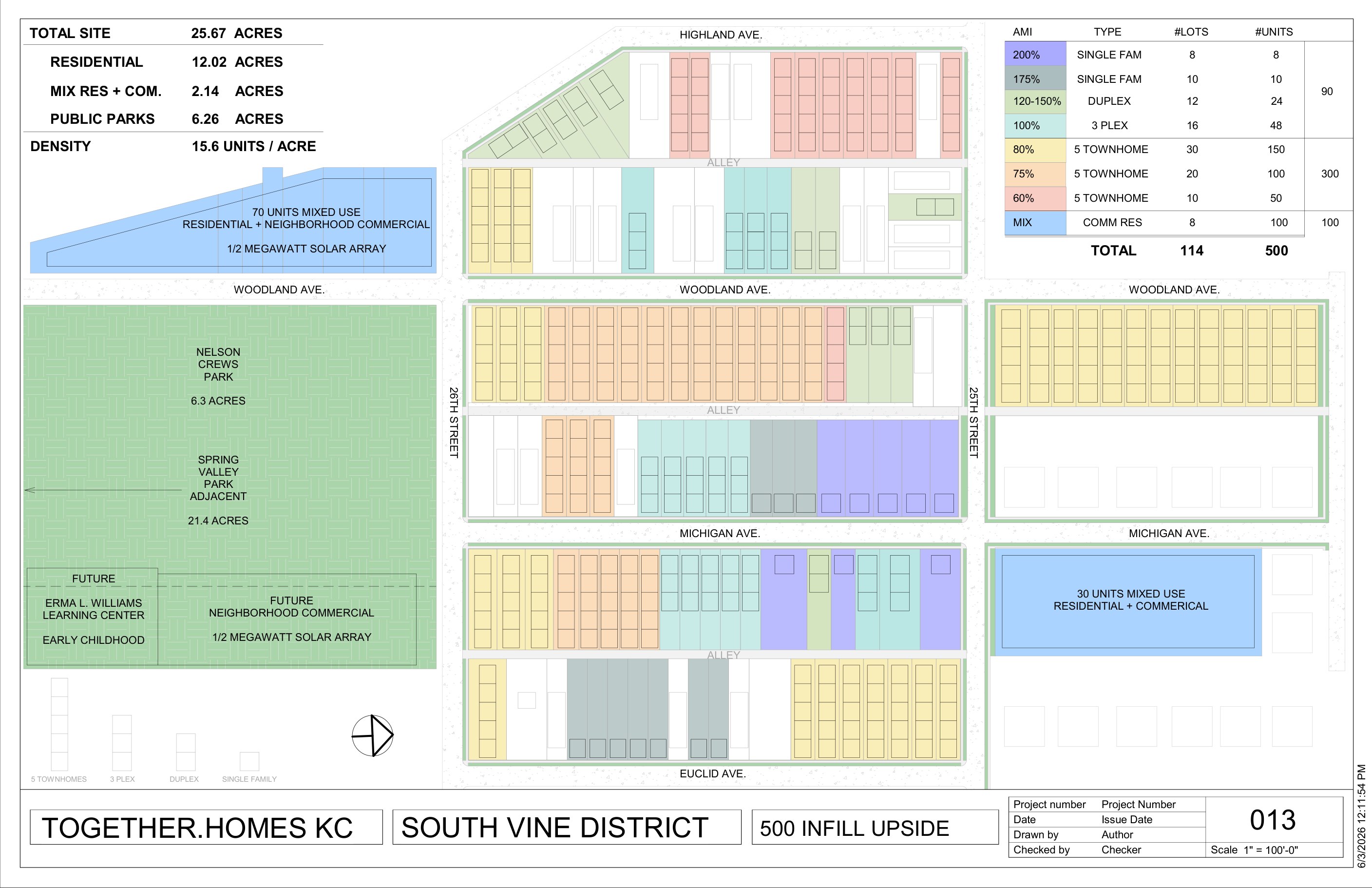
The Demand
HUD CHAS, MARC, and the Mid-America Regional Council document a regional housing shortage that exceeds the 500 Together.Homes KC development by orders of magnitude. The 500-home development addresses roughly 2–3% of the KC CBSA attainable-housing gap (60–120% AMI) — large enough to reset the local comp pool, small enough that oversupply risk is not material.
64,000
Affordable units short across the KC region
MARC, Apr 2023
89%
Of ELI renters in KC cannot find affordable housing
MARC, May 2024
76%
Of KC ELI renters severely cost-burdened (>50% income)
MARC, May 2024
46,000
Rental units needed to cover ELI cost burden
MARC, May 2024
10,000
LIHTC units aging out of affordability over next decade
Industry tracking
−47%
Drop in KC sub-$1,000/mo rentals (2015–2024)
Industry tracking
The Supply Gap
The independent consulting study (Appendix A) is direct: “The City of Kansas City, Missouri has lagged notably behind in this regard, issuing relatively few permits compared to population size.” Within the South Vine PMA specifically, no entitled or in-construction project represents competing supply at the development's scale and price point.
Existing Stock
A bifurcated market: distressed inventory trading $30K–$80K (Land Bank, foreclosure) vs. renovated stock trading $130K–$250K with strong velocity.
New Construction
New-construction homes in adjacent Beacon Hill (64108) already sell at $263–$321/SF — the comp band South Vine prices into. But inside the corridor itself, 2020–2025 permits are limited to projects of fewer than 10 units. Nothing at the development's scale exists in the entitled pipeline.
Vacancy Rate
Substantial KC Land Bank inventory and elevated foreclosure rate provide site acquisition opportunity through partnership channels.
U.S. Census / ACS, South Vine PMA tracts
Tenure Mix
Very high renter concentration represents a large pool of first-time-buyer candidates currently unable to access for-sale product at qualifying price points.
U.S. Census / ACS, Paseo West block group
Subject footprint vs. urban core. The figures above describe the distressed subject tracts specifically. At the broader urban-core scale, the independent Todd Appraisal documents a fundamentally healthy rental market — multifamily vacancy near 8.3% (long-term equilibrium) and roughly 54% renter tenure. The contrast is the opportunity: durable, demand-rich rental fundamentals surrounding a distressed footprint that remains available for site acquisition and redevelopment.
The Coherence Thesis
The independent consulting study introduces a coherence-based value framework: land value within the Primary Market Cohort is “not static, but contingent upon the structure and coordination of development activity.” 500 Together.Homes KC is the operational vehicle that delivers high-coherence development at scale.
Low Coherence
~10% discount
Isolated infill anchored to inconsistent distressed-sale transactions. The status quo that has prevented private capital from entering at scale.
Moderate Coherence
0–10% premium
Clustered projects, partial alignment in product type and timing. Emerging market structure begins to support pricing.
High Coherence (500 Together.Homes KC)
15–30% premium
Coordinated development comparable to greenfield delivery. The appraisal places the premium at 15–30% above baseline, “most pronounced in larger parcels” — a single sponsor delivering 500 transactions in one tract over 30 months.
“Proven new-construction comps already sit about a third of a mile west, in Beacon Hill. When 500 more homes transact within a single census tract over 30 months, they carry that band across the corridor and become the dominant price-setter in it — the comps appraisers must use, no longer across a boulevard but on the block.”
The Keystone Improvement
The appraisal identifies a keystone improvement — a centrally located multifamily or light-commercial anchor — as the first credible signal to the market. Once delivered, it de-risks the surrounding parcels and sets pricing across the entire development, letting downstream lots transact at supported rather than speculative values.
Value Created by Coordination
+125–200%
The appraisal documents that bulk land transforms to finished-lot value at a 125–200%+ uplift as infrastructure, entitlement, and execution risk are absorbed — the quantified payoff of coherent, coordinated delivery.
Pricing
New-construction homes in the immediately adjacent Beacon Hill submarket (ZIP 64108) trade at $263–$321/SF. 500 Together.Homes KC prices every non-custom home at $321/SF — at the top of that proven comp band, not above it. The price carries two independent supports at once: the new-construction sales already closing a few blocks away, and buyer income — 252 of the 500 homes price at 105–106% of area median income, inside the 80–120% workforce band, qualifying at standard mortgage terms with 5% down.
The corridor's own existing East Side resale stock trades at roughly $65–$118/SF — the distressed anchor that has historically failed new-construction appraisals. The adjacent Beacon Hill new-construction comps above resolve that: at $321/SF on every non-custom home, 500 Together.Homes KC prices at the top of the proven $263–$321/SF band, not above it.
Comps: verified 2023–2024 sales and current 2026 listings, adjacent 64108 (Beacon Hill / Forest & Tracy Ave), ~0.35–0.5 mi west of the site across The Paseo. Distances computed from the U.S. Census Geocoder; sale data from Redfin / KCRAR MLS. Full transaction-level comp grid in Appendix D of the PDF.
Income Bands
Workforce housing is defined as 80–120% of area median income; affordable housing as 80% AMI and below. 252 of the 500 homes price at 105–106% AMI — squarely inside the workforce band— and the development blends to 120% AMI, the band's ceiling. It gets there on cost discipline and missing-middle density, not on public money: there is no subsidy in the capital stack, no income cap, no deed restriction, and no resale control on any home. The development makes no affordable-housing claim, and needs none.
Affordable — 80% AMI and below
No homes. The development carries no affordability covenant, income restriction or subsidy directed at this band, and makes no claim to serve it.
Workforce — 80–120% AMI
252 homes at 105–106% AMI — the Type B townhomes and the flats. Unrestricted, market-priced, and financed entirely on private capital.
Market rate — above 120% AMI
248 homes from 126% to 314% AMI — Type A and 3-unit townhomes, duplexes, and the five custom single-family homes.
Incentives are economics
The Chapter 353 abatement and the assigned $2.6M NPA award improve carrying cost and margin. Neither restricts a home, and the model closes without either.
Why unrestricted matters. Subsidy-dependent for-sale housing waits on award calendars, carries decades of compliance monitoring, and cannot reprice with the market. Every home here is an unrestricted fee-simple sale — the schedule answers to nothing but construction, and the collateral is clean.
Tax Abatement Eligibility
Missouri Chapter 353 (Urban Redevelopment Corporations Law) and Chapter 99 (LCRA) provide a 25-year property-tax abatement for areas a municipality designates as “blighted.” Under §353.020, eligibility is set at the redevelopment-area level — the City declares the area blighted by ordinance, and a parcel need not qualify on its own so long as the area on the whole does. The statistics below are the documented evidence supporting that finding for the South Vine area (Census Tract 162, immediately adjacent to the Beacon Hill 353 redevelopment). Final designation rests with the City of Kansas City and EDCKC.
Standard KCMO Structure
The standard abatement under both Chapter 353 and Chapter 99 (LCRA). Administered by the Economic Development Corporation of Kansas City (EDCKC).
Beacon Hill Precedent
The directly analogous Beacon Hill redevelopment — immediately adjacent — received a 25-year Chapter 353 abatement under similar distressed-area conditions.
Median structure ~56 years old; subject block group built 1938
Statute requires ≥50 years
Vacancy rate 16.8% (subject block group 28.9%)
Statute requires meaningfully elevated
Median family income 32.6% of the metro median
QCT threshold ≤60% of AMI
Child poverty rate 64.6%
QCT threshold ≥25%
Mortgage denial rate 11.47% Black vs. 6.42% baseline
Capital-access disparity documented
KCMO MVA 2024 tier F/G designation
City reinvestment program eligibility tier
Fragmented ownership / unclear deed-of-record
Statute lists diversity of ownership as criterion
Tract statistics: U.S. Census Bureau, ACS 2020–2024 5-Year Estimates, Census Tract 162 (Jackson County, MO) and its subject block group. Income shown against the KC MSA median family income. Blighted-area designation is a City of Kansas City determination; figures here are the supporting evidence, not a legal opinion.
The Direct Analog
Beacon Hill — a ~90-acre, mixed-use redevelopment immediately adjacent to the South Vine site in the same East Side urban core — demonstrated that coordinated, abatement-supported residential production can shift a distressed submarket to active reinvestment. Its recent new-construction sales are the comps South Vine prices into today. 500 Together.Homes KC is structured to replicate the absorption mechanism while addressing the affordability gap Beacon Hill did not.
~90
New homes delivered
~450
Multifamily units delivered
25 yr
Chapter 353 abatement (100%/10 + 50%/15)
Hotel + Retail
Mixed-use components delivered
The independent appraiser writes: “In strictly economic terms, Beacon Hill demonstrated that east side land could again command capital, absorb new housing, and support a premium tax base.”
500 Together.Homes KC inherits Beacon Hill's market-reentry mechanism and answers its distributional lesson with supply rather than restriction — 252 of its 500 homes price inside the 80–120% workforce band on the development's own economics, delivered at a scale and pace no subsidised programme in the tract has approached: 500 homes in 30 months.
Independent Third-Party Review
The market analysis is anchored in an independent third-party Restricted Appraisal Consultation & Development Study prepared by Todd Appraisalin conformance with USPAP Advisory and Consulting Standards (effective April 13, 2026). The full final restricted report is provided to qualified reviewers through the controlled data room and provides independent validation of the 500 Together.Homes KC thesis from a source whose interests are not aligned with the sponsor's.
Formal definition of South Vine District market boundaries; demand segmentation; affordability thresholds; tenure preferences; demographic characterization.
KC MSA and urban core market conditions; capital markets; single-family and multifamily analyses; comparable sales framework; coherence-based value adjustments.
Development scenario analysis; absorption potential; sensitivity to key assumptions; Beacon Hill case study; stadium-spillover analysis; keystone-improvement framework.
Read the Full Analysis
The full Market Study & Demand Analysis is approximately 50 pages with six appendices, including the third-party USPAP consulting valuation, HUD CHAS tables, Census ACS pulls, and a complete map portfolio.
For institutional investors, senior lenders, and municipal partners evaluating 500 Together.Homes KC.
Disclosures.This page summarizes a sponsor-prepared Market Study & Demand Analysis. It is not a property appraisal under USPAP Standards 1 and 2, nor an offering document. It does not constitute a solicitation to invest. Offers may only be made under a separately delivered Private Placement Memorandum and subscription documents. Forward-looking statements regarding pricing and absorption are estimates based on current data and reasonable assumptions; actual results may differ materially. Tax-abatement eligibility is a sponsor assessment under existing Missouri statute and KCMO ordinance and is not a legal opinion; final designation rests with the City of Kansas City. Sources cited inline and in the full PDF. Back to together.homes.